How Surge Travels & Standard Waveforms
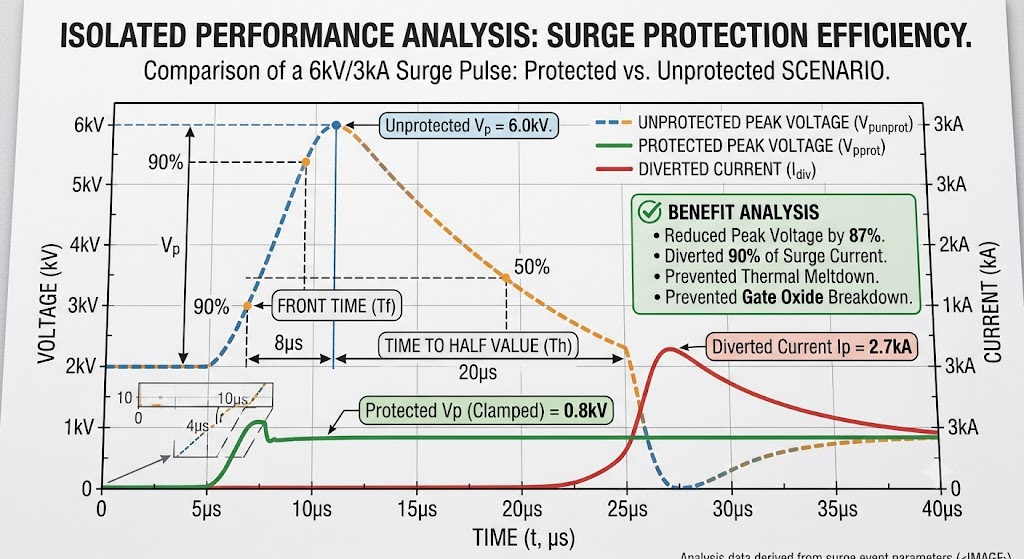
Surge doesn't care what kind of cable it's riding on -- power, Ethernet, RS-485, or a telephone line all provide a path in. IEC 61000-4-5 captures the resulting real-world transient with two standardized reference waveforms: a 1.2/50 µs open-circuit voltage and an 8/20 µs short-circuit current.
Any conductor entering or leaving an enclosure is a potential surge path. Select an interface to see its typical exposure and coupling mechanism.
IEC 61000-4-5's combination-wave generator produces an open-circuit voltage with a 1.2 µs virtual front time and a 50 µs time to half-value, and (when short-circuited) an 8 µs / 20 µs current -- the classic "1.2/50, 8/20" combination wave. Adjust the parameters below to see how the resulting voltage, current, instantaneous power, and delivered energy change.
Module 3 Quiz
Select the best answer for each question. Instant feedback is provided after each response.