Introduction to Surge Immunity
A surge is a short, high-energy transient overvoltage that rides in on a power or signal cable -- caused by lightning, or far more commonly, by something switching off nearby. Unlike ESD, surge combines a moderate voltage with a huge amount of energy, which is exactly what makes it capable of vaporizing a trace or welding a relay contact shut.
A surge is a transient overvoltage lasting from a few microseconds to a few hundred microseconds, carrying substantial energy -- often several joules and sometimes tens of joules on unprotected AC mains. It is distinct from the electrostatic discharge covered in this site's ESD course: ESD delivers a very high voltage (kilovolts) but almost no energy (microjoules) in a nanosecond-scale pulse; surge delivers a comparatively lower voltage but a huge amount of energy over a much longer (microsecond-scale) pulse.
Every one of these terms describes a different kind of electrical disturbance, each with its own test standard and protection strategy. Select one below to see how it compares.
| Transient | Typical Voltage | Typical Energy | Typical Duration | Governing Standard |
|---|---|---|---|---|
| ESD | 2-15 kV (up to 25 kV) | Microjoules | Nanoseconds | IEC 61000-4-2 |
| EFT / Burst | 0.5-4 kV | Millijoules | Nanosecond bursts | IEC 61000-4-4 |
| Surge | 0.5-6 kV (up to 20 kV+) | Joules to tens of joules | Microseconds | IEC 61000-4-5 |
| Overvoltage / Swell | 10-20% above nominal | Continuous | Cycles to seconds | IEC 61000-4-11 / 4-34 |
| Spike | Varies, often surge-related | Small relative to surge | Microseconds | Often bundled with surge testing |
| Noise | mV to a few V | Low, continuous | Broadband / continuous | Various conducted/radiated EMC tests |
| Lightning (direct strike) | Millions of volts | Thousands of joules | Tens of microseconds | Not directly reproduced -- surge simulates its indirect coupled effects |
| Load Dump (automotive) | 40-120 V | Tens of joules | Tens to hundreds of ms | ISO 7637-2 |
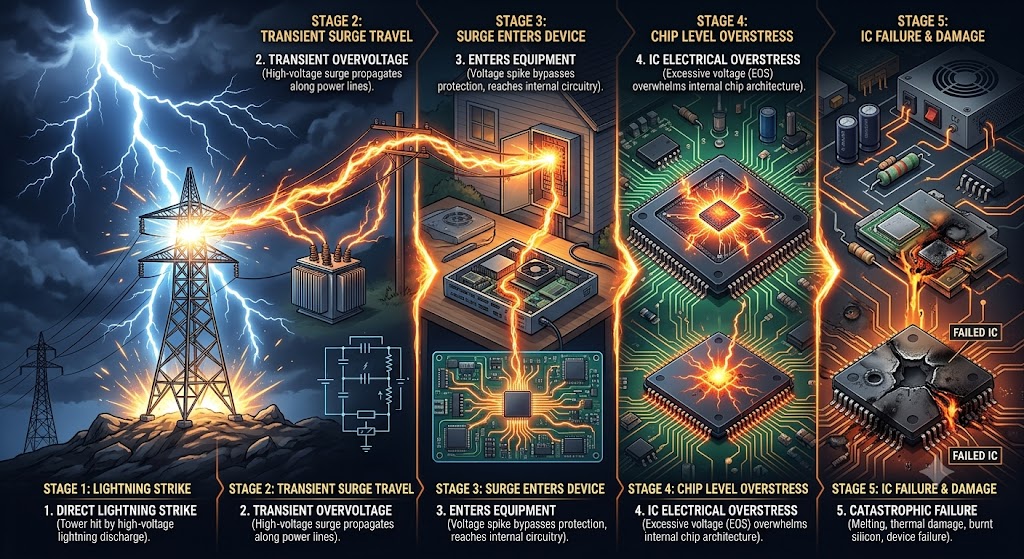
Most surge damage doesn't come from a direct strike on a building -- it comes from an indirect strike kilometers away that induces a transient on the overhead or underground power distribution network, which then propagates into every connected building and, eventually, every unprotected product plugged into the wall.
Module 1 Quiz
Select the best answer for each question. Instant feedback is provided after each response.